If you make wine in the Margaret River, Swan Valley or elsewhere in Western Australia, Wine Equalisation Tax (WET) can have a meaningful impact on your cash flow.
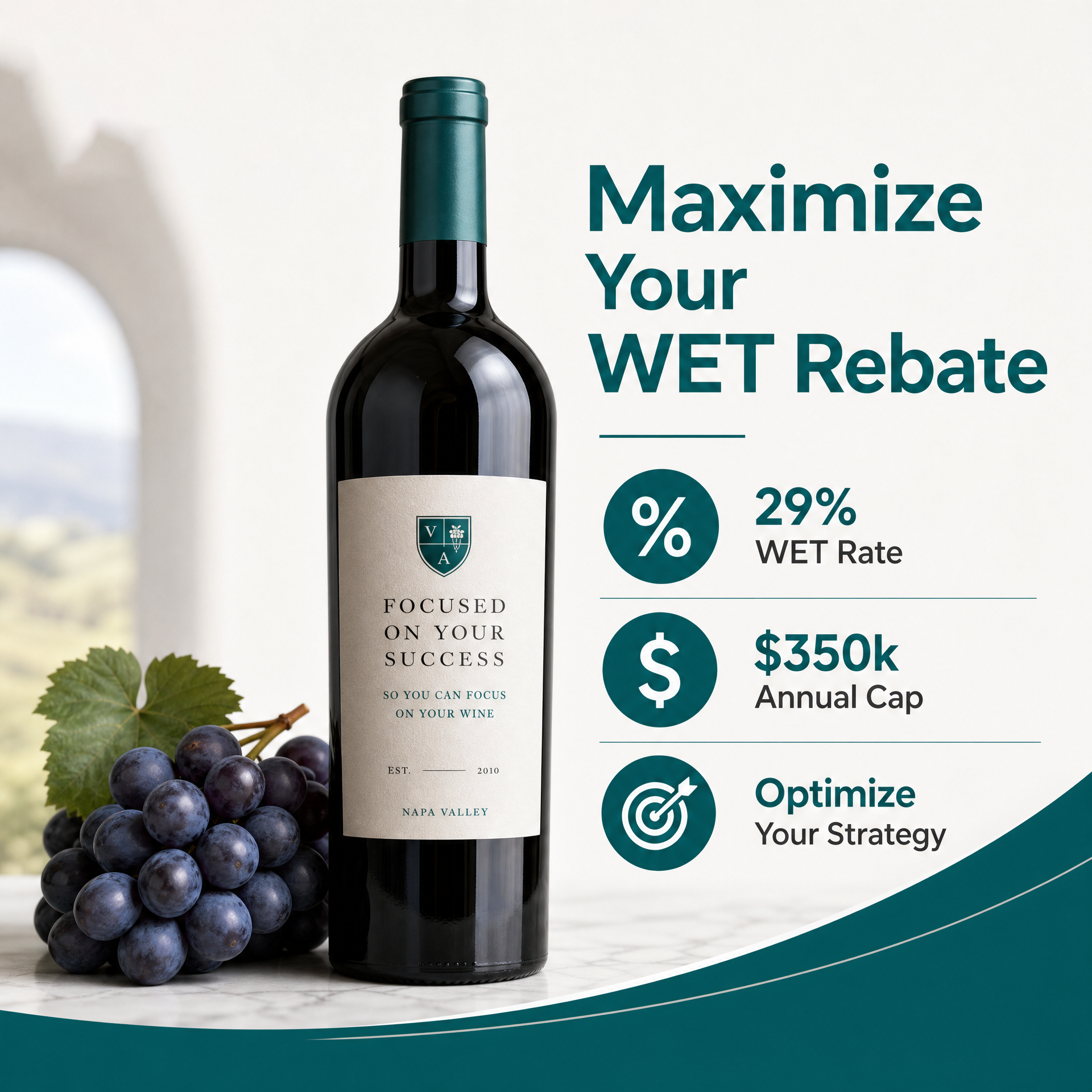
The good news is that eligible Australian wine producers can claim a producer rebate of up to $350,000 per financial year. The challenge is getting the WET calculation, rebate and BAS treatment right.
This guide explains how WET works in 2026, including wholesale sales, cellar-door sales, the producer rebate and what WA wineries should watch for.
What Is Wine Equalisation Tax?
Wine Equalisation Tax is a 29% federal tax on the taxable value of wine sold or otherwise dealt with in Australia. WET can apply to:
- grape wine
- grape wine products
- fruit and vegetable wines
- cider and perry
- mead
- sake.
It generally does not apply to beer, spirits and other products that fall under different alcohol tax arrangements.
WET is designed to be a once-only tax, generally applying to the last wholesale sale before the wine reaches the retail customer. Quoting and credit rules help prevent WET from being compounded through multiple wholesale transactions.
How Is WET Calculated?
For a normal wholesale sale, WET is generally calculated at 29% of the selling price excluding WET and GST. For example, suppose a winery sells a case to a distributor for $120 excluding GST and WET.
WET: $120 × 29% = $34.80
GST is then calculated on the relevant GST-inclusive amount, including WET.
The important point is that WET is not simply another 29% added to the customer’s retail price. The taxable value depends on the type of dealing and the WET rules applying to that transaction.
What Happens With Cellar-Door Sales?
This is where many wineries get WET wrong.
When you sell wine directly to consumers through your cellar door, online store, wine club or another retail channel, there may be no wholesale transaction to use as the taxable value.
For retail sales of grape wine, the WET Act provides a half-retail-price method for calculating the notional wholesale selling price. The taxable value is generally 50% of the retail sale price, including WET and GST.
Example: $30 Cellar-Door Bottle
Suppose you sell a bottle of grape wine for $30, including GST and WET.
Notional wholesale selling price: $30 × 50% = $15
WET: $15 × 29% = $4.35
So the WET component calculated under the half-retail-price method is $4.35.
Some producers may be able to use the average wholesale price method instead, provided they meet the requirements for that method. This is one area where getting specialist advice can make a difference.
The $350,000 WET Producer Rebate
For eligible Australian wine producers, the WET producer rebate is arguably the most important part of the WET system.
The maximum rebate is currently $350,000 per financial year.
The rebate is calculated broadly at 29% of the relevant taxable value of eligible producer dealings, subject to the annual cap.
That means the maximum rebate effectively covers WET on approximately $1.2 million of eligible wholesale value each year.
The ATO confirms that the $350,000 limit also applies across a group of associated producers, rather than allowing connected businesses to multiply the cap.
Who Can Claim the WET Producer Rebate?
The producer rebate is not available simply because you sell Australian wine.
Broadly, an eligible producer must:
- be the producer of the relevant rebatable wine
- be registered or required to be registered for GST in Australia
- make an eligible taxable dealing with the wine
- satisfy the WET producer requirements for the wine and how it was produced.
The producer rules can become more complicated when wine is made from grapes, fruit, juice or wine purchased from another producer.
For example, buying grapes and making wine yourself is not automatically the same as buying finished bulk wine and simply rebottling it.
Where a winery uses purchased grapes, juice, must or wine, the exact production arrangement matters. This is an area where the details of the transaction should be reviewed rather than relying on a simple rule of thumb.
The $350,000 Cap and Associated Producers
The $350,000 rebate limit applies to a producer for the financial year.
However, if businesses are associated producers, the $350,000 maximum applies to the group rather than each entity separately.
This is particularly important where a wine business operates through multiple companies, trusts or related entities.
For example, creating two related winery companies does not automatically create two separate $350,000 rebate entitlements.
The ATO can apply associated-producer rules where entities are connected or one entity is subject to the directions or wishes of another in relation to its financial affairs.
Is There a Separate WET Registration?
Not in the way many wineries assume.
There is not a standalone “WET registration” equivalent to registering for GST.
The producer rebate is available to producers that are registered or required to be registered for GST, subject to the WET rules.
Your WET obligations are generally dealt with through the BAS and GST reporting system.
That means a winery’s GST registration, accounting records and BAS reporting need to be set up correctly from the beginning.
How Is WET Reported on the BAS?
WET is reported through the BAS for the relevant tax period. The ATO uses:
- Label 1C for WET payable
- Label 1D for WET credits, including eligible producer rebates.
Your reporting period depends on your GST reporting arrangements, so don’t assume every winery automatically reports WET quarterly.
The producer rebate is claimed in the relevant tax period in accordance with the WET rules.
This is why your BAS and WET calculations should be reconciled carefully before lodgement.
For wineries that want someone else to handle the activity statement and WET calculations, see our BAS lodgement service.
WET Is Only One Part of Winery Tax
WET rarely exists in isolation. A growing winery may also need to consider:
Business structure
Whether the vineyard and winery operate as a sole trader, partnership, company or trust can affect tax, asset protection, succession and how profits are distributed.
Our guide to sole trader vs company explains some of the key differences.
Depreciation
Winery businesses can have significant investments in equipment and infrastructure, including tanks, bottling equipment, refrigeration, irrigation and other plant.
The tax treatment depends on the asset and the circumstances. Our business asset depreciation calculator can help you estimate the potential tax treatment of business assets.
Tax planning
Timing major equipment purchases, reviewing business structure, managing taxable income and planning for capital transactions can all form part of a winery’s broader tax strategy.
Our tax planning service is designed around making those decisions before the financial year closes rather than discovering the tax consequences afterwards.
Common WET Mistakes We See
1. Using the wrong cellar-door calculation
The 80% RRP formula often appears in older or inaccurate online articles. It should not be used as the general method for calculating WET on retail sales of grape wine.
The half-retail-price method is generally 50% of the retail sale price, including WET and GST, unless another permitted method applies.
2. Treating the rebate as $350,000 of cash back
The rebate is not a generic government payment simply for being a winery.
It is calculated against eligible producer dealings and WET, subject to the rules and annual cap.
3. Assuming related entities get separate caps
Associated producers can share the same $350,000 maximum.
The structure of the winery group therefore matters.
4. Forgetting WET when preparing the BAS
WET needs to be accounted for alongside the winery’s broader GST and BAS obligations.
A bookkeeping system that does not correctly identify taxable wine dealings can create problems at BAS time.
5. Assuming every wine product is treated the same
WET has specific definitions and rules for different categories of wine and wine products.
Cider, fortified wine, mead, sake and other products should not automatically be treated as identical to ordinary grape wine.
What Should a Margaret River or Swan Valley Winery Do?
If your winery sells wholesale and through the cellar door, your WET calculation may involve different taxable-value rules for different sales.
That means your accounting system should clearly distinguish:
- wholesale sales
- retail and cellar-door sales
- wine subject to quoting
- eligible producer rebate dealings
- wine purchased from other producers
- associated-entity transactions.
The biggest WET savings often come not from finding an obscure loophole, but from getting the rebate and transaction treatment right from the beginning.
For wineries that are expanding, acquiring vineyards or changing structures, WET should also be considered alongside income tax, GST, depreciation and capital gains tax.
WET for WA Wineries: The Bottom Line
For an Australian wine producer, the headline numbers are simple:
- WET rate: 29%
- Producer rebate: Up to $350,000 per financial year
- Cellar-door grape wine: Generally calculated using a 50% notional wholesale selling price under the half-retail-price method
BAS: WET payable is reported at 1C, while WET credits including the producer rebate are reported at 1D
The difficult part is applying those rules to your actual winery.
For a Margaret River or Swan Valley producer selling through a mixture of cellar door, online, restaurant, distributor and wholesale channels, the tax outcome can change depending on how each transaction is structured and recorded.
Make Sure Your Winery Is Claiming What It Is Entitled To
At KSH TAX, we help Australian businesses with WET, BAS, tax planning, business structures and broader tax compliance.
If you’re a WA winery and want to check that your WET calculations and producer rebate are being handled correctly, book a free consultation or call us at 08 6285 8110.