If you work as a nurse or midwife in Australia, you may be paying for professional registration, uniforms, protective footwear, training, travel between work locations and other work-related expenses throughout the year.
Some of these costs can be deductible. Others cannot.
And from 1 July 2026, there is another important change: eligible Australian resident workers with assessable labour income can access a standard deduction of up to $1,000 for work-related expenses under the new 2026–27 rules.
So, what can nurses actually claim on tax?
Here is what you need to know for the 2026–27 financial year.
Important: Tax rules can change. This guide reflects the position checked by KSH TAX as at August 2026 and is general information, not personal tax advice.
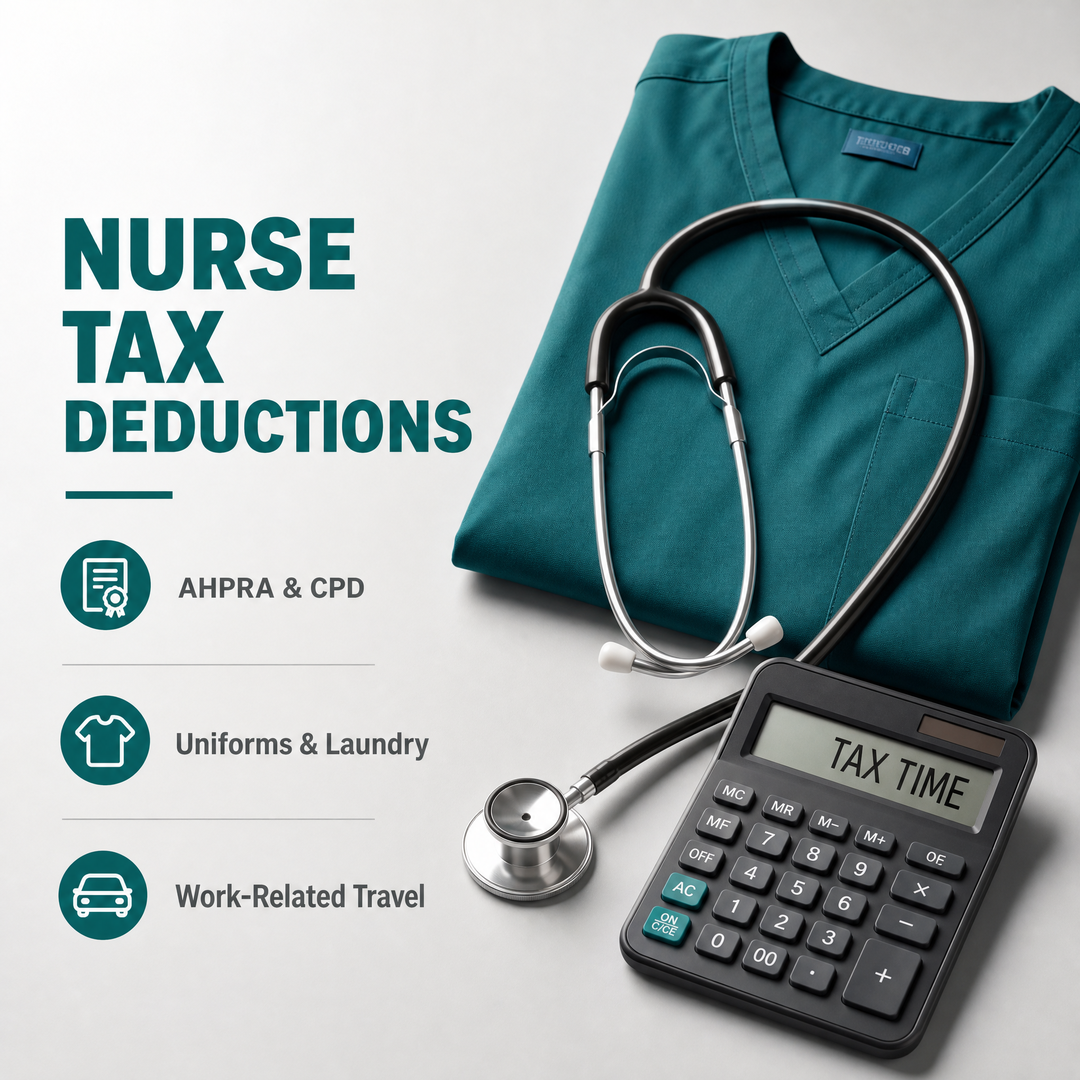
AHPRA Registration and Professional Fees
Your annual AHPRA registration renewal can generally be claimed where the registration is required for your current nursing employment.
The same can apply to relevant:
- Nursing union fees
- Professional association fees
- Annual practising certificate fees
- Professional publications and journals
- Other work-related professional memberships.
The key distinction is that renewing a registration required for your current work is different from the initial cost of obtaining a qualification or registration to enter the profession.
The ATO’s nurse and midwife guidance specifically identifies annual practising certificate fees and relevant professional association costs as potentially deductible work-related expenses.
Keep your renewal confirmation and payment records so you can support the claim.
Can Nurses Claim Scrubs and Uniforms?
Sometimes.
The tax treatment depends on what the clothing is and why you are required to wear it.
Nurses may be able to claim clothing that is:
- Protective, such as qualifying non-slip nursing shoes
- Occupational-specific
- A compulsory uniform that meets the relevant requirements
- Otherwise eligible under the ATO’s clothing rules.
Plain everyday clothing is generally not deductible simply because you wear it to the hospital.
For example, an ordinary pair of black trousers that could be worn outside work does not become deductible because your employer’s dress code says you must wear black trousers.
The ATO’s own nurse and midwife guidance identifies items such as non-slip nursing shoes and qualifying scrubs as examples of clothing that may be deductible.
Laundry and maintenance costs can also be deductible where the underlying clothing qualifies.
For more detail, see our guide on work clothes tax deductions.
What About Nursing Shoes and Protective Equipment?
Work-related protective equipment can potentially be claimed where you purchase it yourself and it is connected to your employment.
Examples can include qualifying:
- Non-slip nursing shoes
- Protective gloves
- Masks or other personal protective equipment
- Other equipment required to protect you from workplace risks.
Don’t assume every item you personally use at work is deductible. The expense still needs to satisfy the normal work-related deduction rules.
Self-Education, CPD and Nursing Courses
This is one of the more valuable areas for many nurses.
Self-education expenses may be deductible when the study has a direct connection with your current employment.
For example, a course may qualify where it maintains or improves the skills and knowledge you need in your current nursing role, or is likely to increase your income from that employment.
Potential expenses can include:
- Eligible course fees
- Textbooks and professional publications
- Stationery
- Certain travel costs
- Internet or other study-related expenses where the work-related portion can be established.
The ATO specifically gives continuing professional development and relevant postgraduate study as examples of education that may qualify for nurses and midwives.
The important boundary is that study designed to help you enter a new occupation or substantially different career is generally not deductible.
So, don’t assume that every nursing-related degree qualifies just because it is connected to healthcare.
Travel and Car Expenses for Nurses
Driving from your home to your normal workplace is generally private and cannot be claimed.
Travel can be different when you are travelling:
- Between two workplaces
- From one hospital or clinic to another
- To patients’ homes as part of your employment
- Between work locations during your duties
- To another workplace for work-related purposes.
For car expenses, eligible employees can generally choose between the cents-per-kilometre method and the logbook method, provided they satisfy the relevant requirements.
For 2026–27, the cents-per-kilometre rate is 91 cents per kilometre, with a limit of 5,000 work-related kilometres per car.
The logbook method can be more appropriate for nurses who travel extensively for work because it considers actual vehicle expenses and the established work-related percentage.
The crucial point is to keep records showing where you travelled, why you travelled and how the trip related to your work.
Working From Home
Nurses who work from home may have some additional expenses to consider.
For example, you may occasionally complete:
- Patient administration
- Care documentation
- Rostering or work administration
- Training
- Continuing professional development.
However, working from home does not automatically make your household expenses deductible.
Eligibility and record-keeping requirements apply, and the rules can differ depending on whether you use the fixed-rate method or actual-cost method.
Don’t simply calculate your home internet bill and claim a percentage without records supporting the work-related use.
Tools, Equipment, Phones and Technology
Nurses can also use specialised equipment as part of their work.
Potential examples include:
- Stethoscopes
- Watches or pin watches used for clinical duties
- Specialist nursing equipment
- Work-related technology
- Phones and data used for employment
- Other equipment used directly in your nursing duties.
The ATO’s nurse guidance specifically recognises tools and equipment such as stethoscopes and pin watches as potentially deductible.
Where an item is used partly for private purposes, you generally need to claim only the work-related portion.
For a more expensive asset, depreciation may also need to be considered rather than assuming the entire purchase price can be deducted immediately.
Phone, Internet and Data
A nurse may be able to claim the work-related portion of phone, data and internet expenses where there is a genuine connection with employment.
But simply using your personal phone to:
- Check your roster
- Read payslips
- Message your manager about shifts
does not automatically make the entire phone bill deductible.
You need to determine and support the work-related portion.
The New $1,000 Standard Deduction for 2026–27
This is the biggest change nurses need to know about for the new financial year.
From 1 July 2026, eligible Australian resident individuals with assessable labour income can access a standard deduction of up to $1,000 for work-related expenses.
The standard deduction is designed to simplify claims for workers with relatively modest work-related expenses. It is not an extra $1,000 that you simply add on top of every other work-related deduction.
The legislation sets out how the standard deduction interacts with other work-related deductions, so nurses with larger actual expenses may still need to consider the ordinary deduction rules.
This also means older articles about the traditional work-related expense substantiation thresholds may not accurately describe the rules that apply for 2026–27.
What Nurses Cannot Claim
Some expenses are commonly claimed by healthcare workers but generally aren’t deductible.
These can include:
- Travel between home and your normal workplace
- Ordinary everyday clothing
- Personal medical expenses
- Private health insurance
- Childcare
- Fines and penalties
- Expenses paid or reimbursed by your employer
- Study that is unrelated to your current employment or qualifies you for a new occupation.
The basic test is simple: Was the expense incurred in earning your taxable income, and is it genuinely connected to your current work?
Personal expenses don’t become deductible simply because they make it easier or more comfortable to do your job.
What About Agency Nurses and Nurses With an ABN?
Your employment arrangement matters.
A nurse employed directly by a hospital or health service generally claims eligible work-related expenses in their individual tax return.
An agency nurse or healthcare professional operating as a contractor may have additional business tax obligations and deductions.
But having an ABN does not automatically make someone a contractor for tax purposes.
If you’re operating a genuine business, the treatment of expenses, equipment, GST and vehicle costs can be different from the rules applying to an employee.
This is where professional advice becomes particularly valuable.
Midwife Tax Deductions
Midwives generally work under the same broad tax principles as nurses.
Depending on their circumstances, they may be able to claim:
- AHPRA registration renewal
- Professional association fees
- Eligible uniforms and protective clothing
- Professional development and CPD
- Work-related travel
- Eligible equipment
- Phone and internet costs used for work
- Other expenses directly connected with their employment or business.
A privately practising midwife may have additional business expenses, including equipment and professional insurance, depending on how the practice operates.
Keep Better Records Throughout the Year
Good record keeping makes tax time much easier.
Keep your:
- AHPRA renewal confirmation
- Professional membership receipts
- Uniform and equipment receipts
- Course and CPD invoices
- Travel records
- Vehicle records
- Phone and internet records
- Evidence showing how you calculated work-related use.
Don’t wait until June or July to reconstruct everything from memory.
A simple digital folder can make a huge difference.
Don’t Leave Legitimate Deductions Behind
Nurses often have a combination of employment expenses that are easy to overlook because no single item looks particularly significant.
AHPRA renewal. Professional memberships. Protective footwear. CPD. Equipment. Work-related travel. Phone costs.
Individually, they may look small. Together, they can make a meaningful difference to your tax position.
KSH TAX helps Australian employees, nurses, healthcare professionals and businesses work through their deductions and lodge their returns correctly.
Our tax returns service covers work-related deductions including vehicles, uniforms, tools and training, with every return reviewed before lodgement.
If you’re looking beyond your annual return and want to understand how to legally reduce your tax across the year, our tax planning service can help you identify the opportunities that apply to your broader financial position.
Need help with your next return? Book a consultation or call us on 08 6285 8110.